Prerequisites
The prerequisites for model training are as follows:
- The process data used to train the model should be available as IoT timeseries in multiple aspects and assets or as CSV file stored in the Integrated Data Lake (IDL). Data preprocessing, including imputation, filtering, and aggregation, is enabled using the Dataset Manager described in Create and Edit Data models. The process data must contain following variables:
| Variable | Description |
|---|---|
| _time (timestamp) | Variable to define date and time of each data point in IoT timeseries |
| Input features (double) | One or more numeric process parameters used as predictors for the process model |
| Filtering features (integer or string) | One or more numeric, boolean or text process parameters are used to define the manufacturing phase |
| Identifier (string) | The parameter to identify produced parts is used for the aggregation of process parameters related to each part's manufacturing process phase. This must be same for each data point associated with the selected part and must be unique for all parts. |
- The quality data used to train the model should be available as a CSV file in the Integrated Data Lake (IDL) or as IoT time series. Data preprocessing, including imputation, filtering, and aggregation, is enabled using the Dataset Manager as well. These data are typically extracted from the quality management system used in a specific manufacturing process. The dataset must include a table with columns representing the variables and their corresponding values. Additionally, the identifiers in the quality data should match the identifiers available in the selected IoT time series process data, as listed below:
| Variable | Description |
|---|---|
| Timestamp (timestamp) | Variable to define the date and time of the quality measurement result. |
| Identifier (string) | Variable containing unique serial number of parts. |
| Target (double) | Numeric variable containing target quality feature to train the model. |
| Tolerance Low (double) | Low tolerance limit used for quality acceptance check. |
| Tolerance High (double) | High tolerance limit used for quality acceptance check. |
- Additional aspect should be available in the IoT model for a selected asset to store quality prediction results. This aspect should contain following variables:
| Variable | Description |
|---|---|
| Target (double) | Variable to store prediction result. |
| Tolerance Low (double) | Variable to store low tolerance limit. |
| Tolerance High (double) | Variable to store high tolerance limit. |
| Identifier (string) | Variable containing unique serial number of parts. If the Timestamp is used as an Identifier, no additional Identifier variable is required. |
- To generate effective predictions, the process data should be updated with new data at the same frequency as the historical data used to train the model.
- The process data must be provided as IoT timeseries to enable real-time prediction of the quality results.
- In the case of missing values of required process variables, these values will be automatically filled using the “Last Observation Carried Forward” (LOCF) method".
- It is necessary to ensure that the identifier value is not empty for each data point both in the process and quality data.
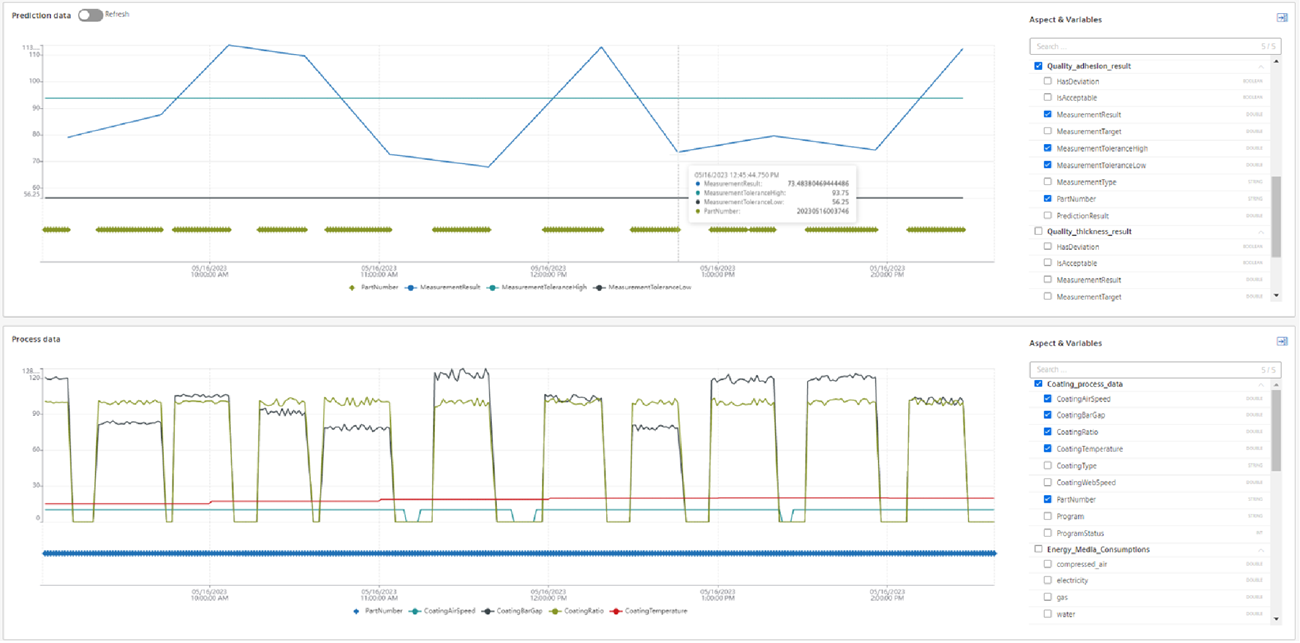
An example of the IoT data model used to work with the manufacturing process and quality data is shown in the image below:

Last update: August 10, 2026